The SEO Payback Planner
Your own click rate in place of the curve, the page priced before it is written, return counted on margin, the months before it ranks paid for, the worst position that still pays back, a stress test, and any monthly fee priced in pages
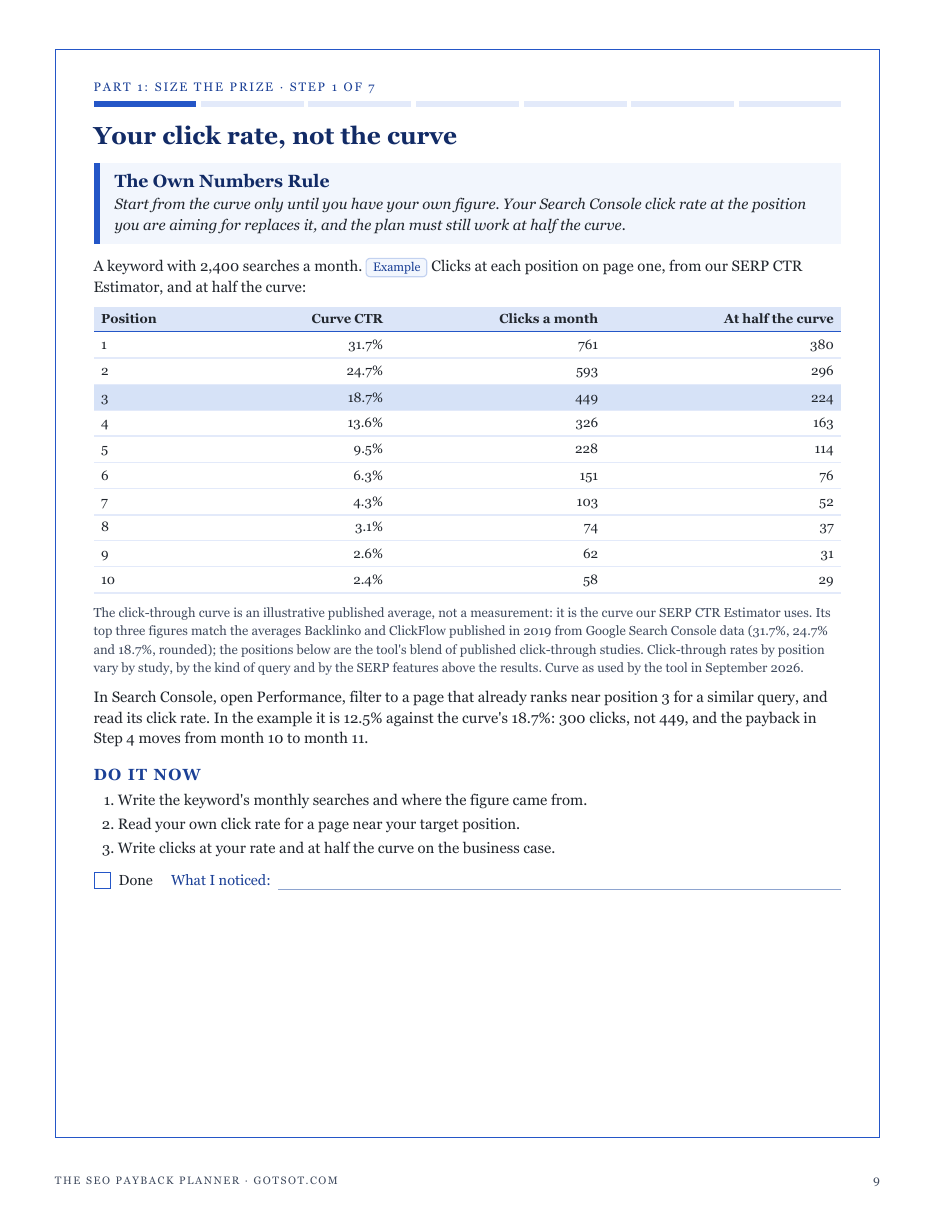
GOTSOT's free SEO calculators each answer one question, and on its own each one flatters the plan. The SERP CTR Estimator reads clicks off a published average curve, not your own click rate. The SEO ROI Calculator compares one month of revenue with one month of spend: no margin, no cost to write the page, and traffic from the first day, as if a page ranked the moment it went live. The Content Word Counter measures a draft but never prices it. The SEO Payback Planner puts the three in order for one page and one keyword. In its worked example, a 2,400 search keyword at position 3 draws 449 clicks a month on the curve, or 300 at an own click rate of 12.5%. A 1,800 word page costs $336 to write and edit. Counted on revenue for one month at full rank, the calculator shows 3,492%; counted on a 40% margin over the first twelve months, with the page's price and six months before it ranks, the return is 108.8%, and the page pays back in month 10. Position 7 is the worst that pays back inside 24 months; at half the clicks and twelve dark months it still pays back in month 19. A $1,000 a month retainer needs 5 such pages at full rank just to cover its fee. Nobody can promise a ranking, traffic or a return, and the planner does not: time to rank is an assumption you choose, the click curve is labelled as an illustrative published average with its source and date, and every figure is computed by the site's own tools from examples, tagged as examples. It names bought links, doorway pages, content spun out at scale and cloaking as spam policy violations, never tactics. You get a 23-page printable PDF with 7 steps, a keyword business case, a 24 month payback tracker, an offer check sheet, a payback reference table and a quickstart, plus a personalised sheet worked out from the numbers you entered in the calculators.
Look inside
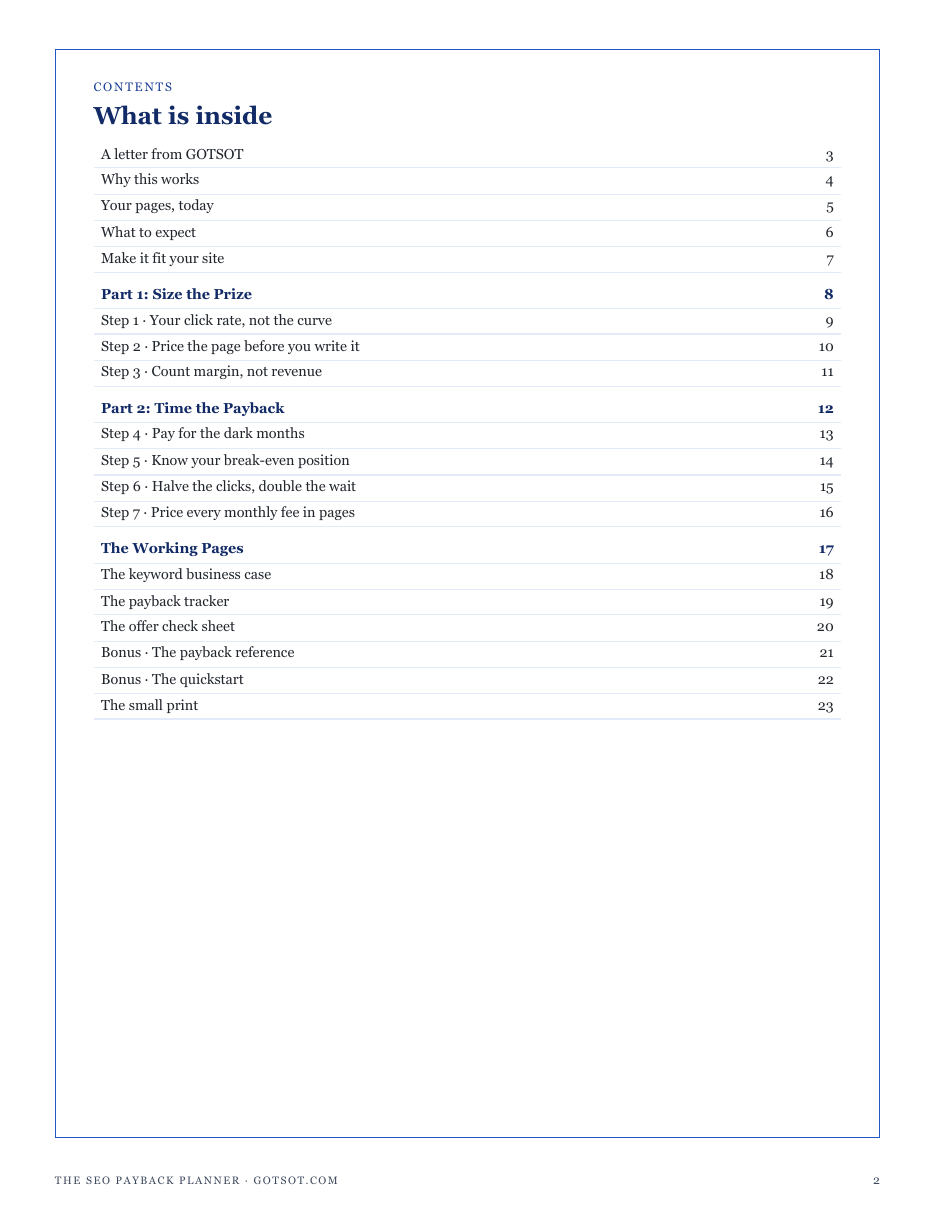
Two full pages from the planner, exactly as printed. Click either to read it at full size before you decide.
What is in it
- The Own Numbers Rule: your Search Console click rate in place of the published curve, and the plan checked at half the curve
- The Page Price Rule: words times the rate plus your editing hours, and each monthly tool bill split across the pages it serves
- The Margin Rule: return counted on gross profit after every cost, beside the return on revenue the calculator shows
- The Dark Months Rule: months with no clicks and a climb, assumed from your own past pages, and the payback month
- The Break-Even Position Rule: the worst position at which the page still pays back inside your horizon
- The Stress Rule: half the clicks and twice the wait, and whether the worst corner still pays back
- The Retainer Rule: any monthly fee priced in the pages that must rank to cover it, and the offers to walk away from
- The keyword business case, printable, for three keywords side by side
- The 24 month payback tracker and the offer check sheet, printable
- A payback reference table by position and search volume, and a one-page quickstart
- ✓ 23 printable pages
- ✓ 10 sections, worksheets and templates
- ✓ A second PDF worked out from the numbers you enter
- ✓ No account needed, just an email address
- ✓ Instant download; link valid 7 days
Price includes any taxes. Sold by GrabURL, who handle checkout and support. The charge appears on your statement as GrabURL.
The planner picks up where the free SEO ROI Calculator leaves off. The calculator compares one month of revenue with one month of spend; the planner counts return on margin, prices the page before it is written, and pays for the months before a page ranks, so you see the month it pays back and the worst position at which it still does. Clicks come from the SERP CTR Estimator, whose curve is an illustrative published average, or better, from your own Search Console click rate, and page length from the Content Word Counter. Nobody can promise a ranking, traffic or a return, and the planner does not: time to rank is an assumption you choose, and the worked figures are examples.